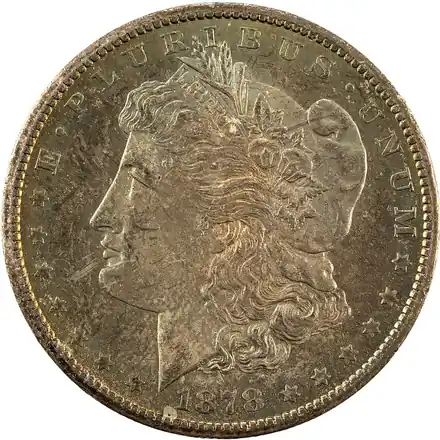
Coin type
Silver Dollars
Morgan and Peace dollars: what they weigh, what they contain, and why so few survive.
Reviewed July 2026 · The Coin Register
The silver dollar is the largest circulating coin most American collectors will handle: 38.1 millimetres across, 2.4 millimetres thick, with a reeded edge. Two designs dominate the field, the Morgan and the Peace, and between them they tell a story less about art than about politics and metal.
Specifications
| Property | Value |
|---|---|
| Mass | 26.73 g |
| Diameter | 38.1 mm (1.5 in) |
| Thickness | 2.4 mm |
| Edge | Reeded |
| Composition | 90.0% silver, 10.0% copper |
| Fine silver | 24.06 g, about 0.7734 troy oz |
| Designer | George T. Morgan |
| Mint marks | None (Philadelphia), CC, S, O, D |
The fine silver figure follows directly from the other two: 26.73 grams at 90 percent leaves 24.06 grams of silver, which is about 0.7734 troy ounces. That number is why people ask what a silver dollar is worth on any given day, and why we cannot tell them. The metal price moves; the coin does not.
Why the Morgan exists at all
The Morgan dollar was not struck because anybody wanted dollar coins. It was struck because Congress required the Treasury to buy silver, and the silver had to go somewhere. When the last of the bullion purchased under the Sherman Silver Purchase Act was coined and the reserves ran out in 1904, the Mint stopped.
Then in 1918 the Pittman Act authorised melting up to 350 million silver dollars. The country eventually melted 270,232,722 of them, and sold 259,121,554 of those to the United Kingdom at a dollar per troy ounce. Coining resumed for a single year, 1921, to replace what had been destroyed, and the Peace dollar took over later the same year.
What the melt means for collectors
Mintage figures for Morgan dollars are a poor guide to rarity, because a coin's mintage tells you how many were made and not how many were spared. Whole date-and-mint combinations went into the furnace. This gap between struck and surviving is the reason a low mintage does not automatically make a key date, and the reason a high mintage does not make a coin common.
The Carson City question
Morgan dollars carry the widest range of mint marks of any American series: none for Philadelphia, plus CC, S, O and D. The CC belongs to the Carson City Mint, established in Nevada to coin the silver of the Comstock Lode, the largest silver strike in the nation's history. It struck gold and silver from 1870 until it closed for good in 1893. A Carson City Morgan is a coin from a mint that existed for barely two decades, which is a large part of why collectors chase them. Where to find the mark, and what the others mean, is in mint marks on coins.
The Morgan design returned in 2021, struck in 99.9 percent silver rather than the old 90 percent alloy. It is a modern collector coin, not a rediscovered antique, and it should not be confused with one.