Coin type
Nickels
Buffalo nickels, Liberty Heads, and the most famous rarity in American numismatics.
Reviewed July 2026 · The Coin Register
The five-cent piece has carried three long-running designs in the modern era: the Liberty Head from 1883, the Buffalo nickel from 1913 to 1938, and the Jefferson nickel that replaced it. Despite the name, a nickel is mostly copper. The Buffalo nickel was struck in 75 percent copper and 25 percent nickel, a composition the Jefferson kept.
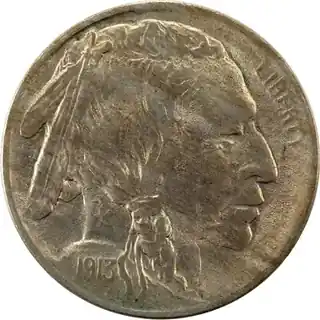
The Buffalo nickel
Sculptor James Earle Fraser designed both sides: a Native American in right profile on the obverse, an American bison on the reverse. Fraser said the obverse was a composite rather than a portrait, and in 1938 named his models as Iron Tail, a Sioux; Big Tree, a Kiowa; and Two Moons, a Cheyenne. Many others have claimed the honor since.
The coin was beautiful and impractical. Dies wore out roughly three times faster than for the Liberty Head, and the date, sitting on a high point of the design, wore away in circulation. The Mint modified the reverse in 1913, raising the bison from a mound onto flat ground and enlarging "FIVE CENTS," which is how collectors separate Type I from Type II. It never fully solved the problem, and dateless Buffalo nickels are common to this day. Our full guide covers the varieties, including the celebrated 1937-D three-legged nickel.
Mint marks on Buffalo nickels sit centered under "FIVE CENTS" on the reverse. Philadelphia coins carry none.
The 1913 Liberty Head nickel
The Buffalo nickel replaced the Liberty Head design in February 1913, and the Mint's official records list no Liberty Head nickels struck that year. Yet five of them exist. They surfaced in 1919 and 1920 in the hands of Samuel Brown, a numismatist who had been a Mint employee in 1913, and many numismatic historians have concluded he may have struck them himself, or had them struck, and removed them from the Mint. Q. David Bowers has argued other explanations are possible, including lawful striking as trial pieces or for cabinet purposes.
Only five are known: two in private hands and three in museums. The Norweb specimen is at the Smithsonian; the McDermott specimen, the only one with circulation wear because its owner carried it around and showed it off in bars, is at the American Numismatic Association's Money Museum. The Walton specimen spent forty years in a closet after an auction house wrongly judged it a fake, and sold in 2022 for 4.2 million dollars.
If you think you have found one
You have not. All five are accounted for, pedigreed, and photographed. Reports of a sixth specimen appear to be unfounded. What people do find are altered dates on ordinary Liberty Head nickels, which is a subject in our guide to counterfeit and altered coins.